NOTE: The correct answer in each case is highlighted in red bold.
Item #19: Which Christmas song was composed in the middle of the First World War, on the basis of a folk song from Ukraine??
Angels We Have Heard on High
Away in a Manger
Carol of the Bells
Frosty the Snowman
Please Come Home for Christmas
Silent Night
Item #19: Commentary
“Carol of the Bells” is a Christmas song, that used the tune from a Ukrainian folk song. Below is a video of each, followed by commentary copied from the well known American history professor of central European history, Timothy Snyder. His column about the song instigated this trivia question.
Section 1: The Christmas version of “Carol of the Bells” – Video performance by Libera, an English boys choir.
Section 2: The original Ukrainian folk song version of “Carol of the Bells” known as Shchedryk – Video performance by @SplendentEileen, “an artist from Ukraine who once decided to combine the profession of a translator and love for music. I wanted more people from my country to be able to understand the meaning of beautiful songs, and so I started recording covers with my translations of my favourite songs. And well, I just love singing.”
I can relate to his feeling of melancholy this Christmas season: Beyond our stink of national politics, there is the continual awareness of Russian attacks on Ukraine and the apparent turnaround by the US government (my government!!) to support the aggressor instead of Ukraine. Not only eastern Europe, but the entire world will suffer the result if Russia is allowed to claim victory.
Thankfully, Snyder shares a number of websites where one can contribute directly in assisting Ukraine. I hope many people contribute regardless of what the rascals in Washington think, and support Ukraine.
EXCERPTS FROM SNYDER’S POST, “O GENEROUS ONE!” ON 12/14/2025:
The other night I heard “Carol of the Bells” echoing from the gallery of a cathedral, and this most beautiful of our Christmas songs made me a little sad.
Long before I knew what the song was called, or anything about it, I thrilled to “Carol of the Bells.” It came to me in my little American capitalist childhood as the background for a television advertisement for André champagne. Even as a very young child, I could tell that there was something strikingly different about the enchanting melody, as though it came from another world. And so it does. …
…“Carol of the Bells” stands out because it arises from a different tradition: that of Ukrainian folk songs, and in particular ancient Ukrainian folk songs welcoming the new year, summoning the forces of nature to meet human labor and bring prosperity. These are called shchedrivky, “carols of cheer” or, a bit more literally, songs to the generous one. The word “magic” is used a good deal around Christmas; this song has its origins in rituals that were indeed magical. And perhaps this is exactly why it reaches us. …
…The melody that I heard in St. Paul’s Cathedral in Toronto as “Carol of the Bells” is a Ukrainian folk song. It was arranged as “Shchedryk” by the Ukrainian composer Mykola Leontovych in the middle of the First World War, likely on the basis of a folk song from the Ukrainian region of Podilia. …
…During and after the First World War, Ukraine was one of the most violent places in the world. Its rich land was contested by multiple armies. A new Ukrainian republican, seeking recognition, sent out a chorus to the world to perform Ukrainian songs. One of these, apparently the most popular, was “Shchedryk,” which was performed in Carnegie Hall.
By then the Ukrainian republic had been destroyed by the Red Army, and the composer Leontovych himself had been murdered, probably by an agent of the Cheka, the Bolshevik secret police. An American composer transformed the song completely with new lyrics in 1936: sentimental, much simpler, about bells and Christmas, without any reference to Ukraine and spring and gratitude. In the American version, the song is about itself and its own cheering effect, but the broader senses are gone. That is the version that we know, the one that left me melancholy in the cathedral. …
…During and after the First World War, Ukraine was one of the most violent places in the world. Its rich land was contested by multiple armies. A new Ukrainian republican, seeking recognition, sent out a chorus to the world to perform Ukrainian songs. One of these, apparently the most popular, was “Shchedryk,” which was performed in Carnegie Hall. …
…This is the fourth winter that Ukrainians have spent fighting a horrible war in horrible conditions. Ukraine resisted Russia’s invasion, and keeps resisting. In countless ways, this helps the rest of us to live normally: to treat Christmas conventionally, to sing songs unmindfully, to take for granted that spring will follow winter. The Ukrainians, to us, are the generous ones. It seems that the least that we could do is remember them while we sing their song. …
…I am personally helping to fundraise for trucks that are outfitted with drone-jamming technology that allows Ukrainian medics to evacuate wounded soldiers from the front. We are most of the way to our goal. If you would like to contribute, please follow this link. Such contributions are tax-deductible in the United States.
If you would like to contribute to the Ukrainian state’s defense of its population, please visit the website of United24. …
Christmas Day Update – 12/25/2025
EXCERPT FROM THE NYT ARTICLE
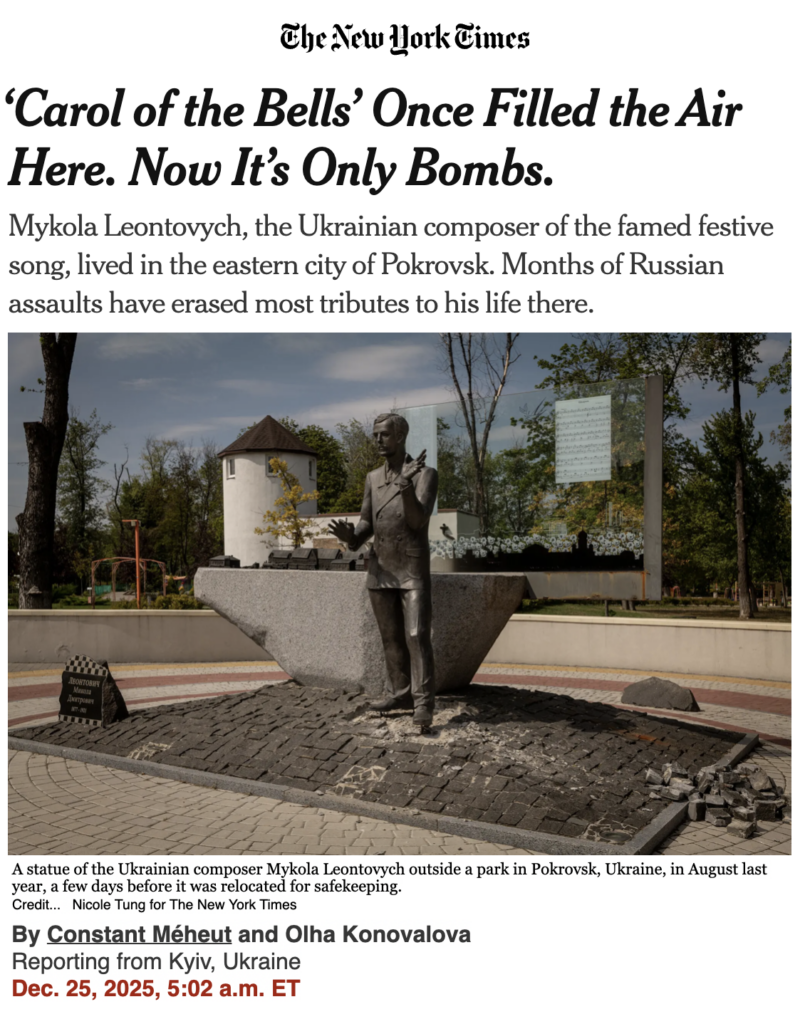
The Ukrainian singer Maryna Krut, wearing a flak jacket, sat by the entrance sign to the embattled eastern city of Pokrovsk and plucked the strings of her bandura, a traditional Ukrainian instrument. The distinctive opening notes of “Shchedryk,” a Ukrainian song known in English as “Carol of the Bells,” filled the air.
It was a moment of musical defiance, just before Christmas last year. Russian forces were less than three miles from Pokrovsk, but Ukrainians were determined to hold the city, a military stronghold. For Ms. Krut, there was also the weight of a cherished cultural heritage. Pokrovsk had once been home to Mykola Leontovych, the composer of “Shchedryk.”
“It’s hard to imagine Christmas anywhere in the world without ‘Shchedryk,’” Ms. Krut wrote in a social media post that included a video of her performance. “As you sing carols this year, remember the price of our ‘Shchedryk.’”
Today, the carol’s notes no longer drift over Pokrovsk. As Ukraine marks its fourth Christmas at war, Russia controls nearly the entire city, which lies in ruins. Through relentless assaults in recent months, Moscow’s troops captured markers of Leontovych’s legacy one by one: the park where his statue once stood, the music school named after him, the building where he assembled choirs in the early 20th century. Combat now unfolds on a street that once bore his name.
The fall of Pokrovsk would be a major setback for Ukraine, making it the largest city taken by Russia in two years. It would give the Kremlin a strategic base to pursue its goal of taking over the eastern Donetsk region of Ukraine. And it would weaken Kyiv’s negotiating position as it discusses a possible peace deal.
For Ukrainians, particularly the tens of thousands who fled Pokrovsk, the city’s capture would mean that a beloved carol will now be forever tinged with loss.
Yevhen Hryhorovych, head of the Pokrovsk Leontovych music school, which has relocated farther west, said, “When I hear ‘Shchedryk,’ I think of Pokrovsk — a city almost destroyed, children who have lost their homes.”
He added, “For us, it will never again be just a festive melody.”
For decades, Pokrovsk was known as a mining city, its skyline punctuated by towering shafts and slag heaps. But in the late 2010s, as Moscow fueled pro-Kremlin separatist movements across eastern Ukraine, local leaders recast the city’s image around its Ukrainian identity.
Leontovych was a natural anchor for that effort. Working as a music teacher in Pokrovsk, then called Hryshyno, from 1904 to 1908, he championed Ukrainian music and supported antigovernment strikes. That put him in the cross hairs of the authorities of the Russian Empire, which governed most of today’s Ukraine and banned him from performing Ukrainian songs, said Tina Peresunko, a Ukrainian researcher who specializes in the history of “Shchedryk.”
Facing mounting pressure, Leontovych fled to western Ukraine, his birthplace. But his pro-Ukrainian activism had made him a marked man, Ms. Peresunko said, and in 1921, he was killed by an agent of the Soviet security services.
Contribute to the Ukrainian state’s defense of its population, by visiting their website at United24.
Item #20: In Charles Dickens’ “A Christmas Carol,” how many spirits (ghosts) visit Ebenezer Scrooge?
None
Two
Three
Four
Six
Twelve
Item #20: Commentary
Item #21: Who was the composer of The Nutcracker ballet?
Igor Stravinsky
Modest Mussorgsky
Nikolai Rimsky-Korsakov
Pyotr Ilyich Tchaikovsky
Serge Koussevitzky
Sergei Rachmaninoff
Item #21: Commentary
Where the story-line came from….
Watch the Nutcracker and listen to Tchaikovsky’s music.
Item #22: Who is NOT a character in The Nutcracker ballet?
The Sugar Plum Fairy
Clara Stahlbaum
Fritz Stahlbaum
The Mouse King
The Dove Queen
Herr Drosselmeyer
Item #22: Commentary
I made up the Dove Queen.
Item #23: In the poem, “The Night Before Christmas,” visions of which food danced in children’s heads?
…a sugar plum is a comfit—that is, a seed, nut, or scrap of spice coated with a layer of hard sugar, like the crunchy outer case of an M&M. In the 17th century, popular innards for comfits included caraway, fennel, coriander, and cardamom seeds, almonds, walnuts, ginger, cinnamon, and aniseed. Tiny comfits—“hundreds and thousands,” “shot comfits,” or nonpareils”—were made by sugar-coating minuscule celery seeds; “long comfits” were sugar-coated strips of cinnamon bark or citrus peel.
The key is the hard layer. Prior to mechanization, this was very difficult and time-consuming. This means that these candies were very expensive prior to the late 1800s, like a luxury item.
This is the best modern presentation I could find:
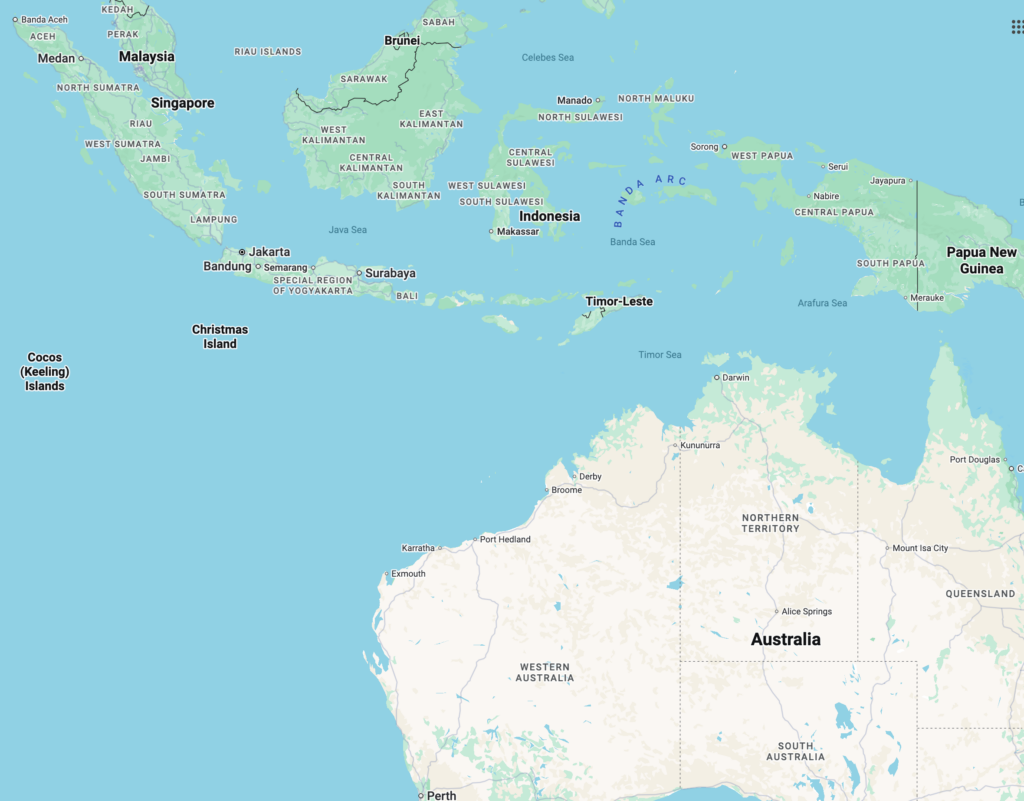
Item #24: The only Christmas Island that exists in the oceans today is a Territory with a national park that includes 60% of the island mass. The Island is today a Territory of what country?
Australia
Indonesia
Malaysia
New Zealand
Singapore
The United Kingdom
Item #24: Commentary
Christmas Island is in the Indian Ocean. It has been a Territory of Australia since 1958. It is a speck of an island (52 sq miles), 840 miles from the closest shore of the Australian continent, with 1,700 residents. [By comparison, Puerto Rico is an American Territory (5,325 sq miles) approximately 1000 miles from Florida, with 3.2 million residents.]
To be clear, there used to be two different Christmas Islands – the other one is an atoll in the Pacific Ocean. In the 1950s and 1960s it was used for atomic bomb testing by the USA and the UK. Today, the island is re-named Kiritimati and has been part of the new Republic of Kiribati since 1979. Kiribati consists of a total of 313 sq miles, counting from 32 atolls and a few tiny islands, spread over a million sq miles of ocean.
Item #25: In America, the first written description of Santa Claus was provided by Clement Moore when his 1823 poem was first published anonymously in a Troy, NY newspaper. In the years that followed, many disparate views of St Nick coalesced around his lines in “‘Twas the Night Before Christmas.” Then in 1863 this artist drew his first of many illustrations of Santa Claus [above]. Moore’s text and this artist’s illustrations are the basis for our Santa Claus. Who was the artist?
But, after Clement Moore and Thomas Nast’s contributions there was one more factor in the development of the American Santa Claus: that was Coca Cola and its own hired artist, Haddon Sundblom who captured the look in 1931 and that is still the basis of Santa today.
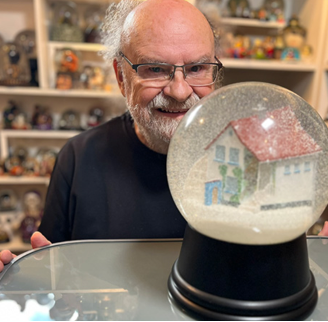
Item #26 – BONUS QUESTION: The man at right is the world record holder for the number of snow-globes that he has collected: now over 11,000 of them! Take a guess who he is from the list below:
Ciaran McGuinness, in Tralee, Ireland
Gert Kofler, in Linz, Austria
John Steeves, in St John, NB, Canada
Josef Kardinal, in Nuremberg, Germany
Oscar Larsen, in Copenhagen, Denmark
Paul Parker, in Bournemouth, England
NOTE: This BONUS Question does not count toward your score. It only counts if there is the need to break a tie based on scores for Questions #1-25 (4 points each).
Item #25: Commentary
To View Quiz Questions #1-18, Use the Links Below: