
NOTE: The correct answer in each case is highlighted in red bold.
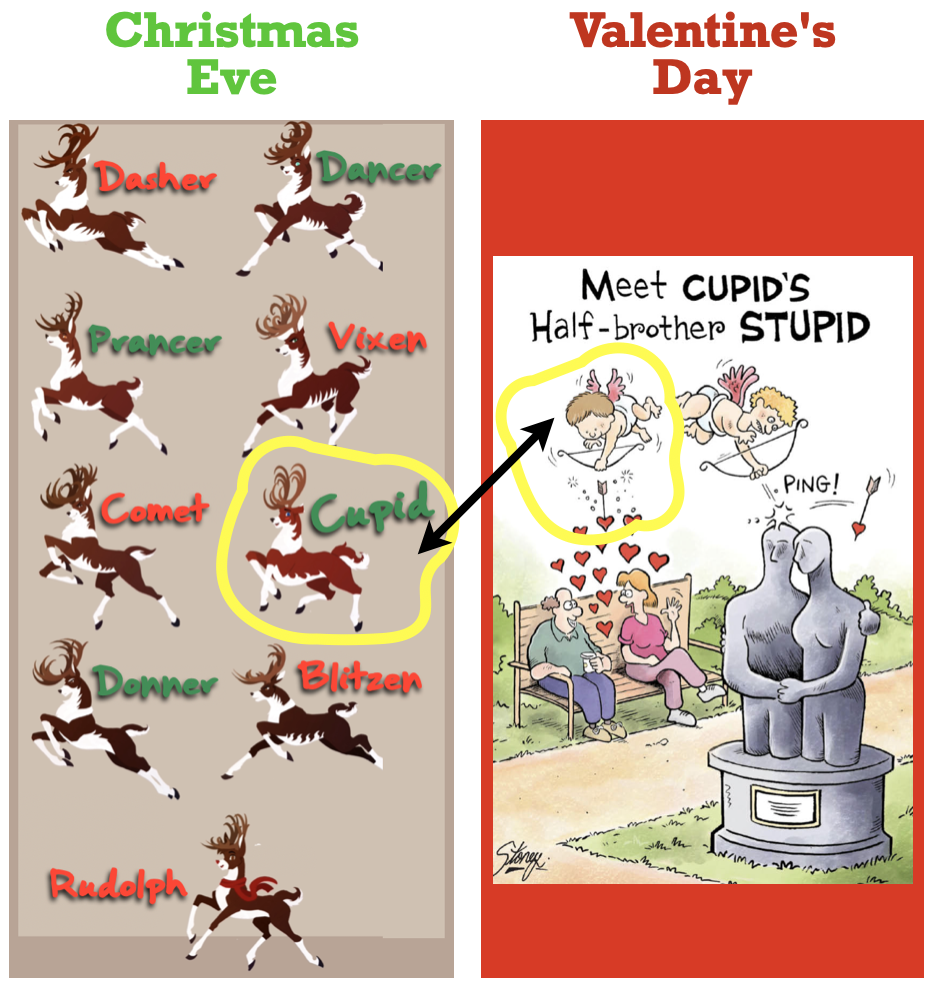
Item #12: Which of Santa’s reindeer has a name that can be associated with another holiday, in addition to Christmas?
- George [Not a reindeer in the Santa tradition]
- Cupid
- Martin [Not a reindeer in the Santa tradition]
- Prancer
- Rudolph
- Vixen
Item #12: Commentary

Item #13: Which is a traditional decoration to hang on the Christmas tree in Ukraine?
- A candy cane
- A sheet of music
- A small sack of frankincense
- A sock
- A spiderweb
- Dry seaweed from the Black Sea
Item #13: Commentary
Two Videos:
Item #14: When did the Catholic Church erect the first Vatican Christmas tree?
- 1756
- 1782
- 1856
- 1882
- 1956
- 1982
Item #14: Commentary
Item #15: Which member of the British royal family popularized the modern Christmas tree throughout England and the rest of the UK?
- King George III in the 1810s
- Queen Victoria in the 1930s
- Prince Albert in the 1840s
- Princess Alexandra in the 1890s
- King George V in the 1920s
- Princess Diana in the 1980s
Item #15: Commentary
Item #16: From where does the Yule log cake originate?
- Denmark
- France
- Germany
- Norway
- Scotland
- Sweden
Item #16: Commentary [Text from Wikipedia, edited for brevity]
A Yule log or bûche de Noël is a traditional Christmas cake, often served as a dessert, especially in France, Belgium, Luxembourg, Switzerland, Lebanon, Vietnam, and Quebec, Canada. Variants are also served in the United States, and in other countries.
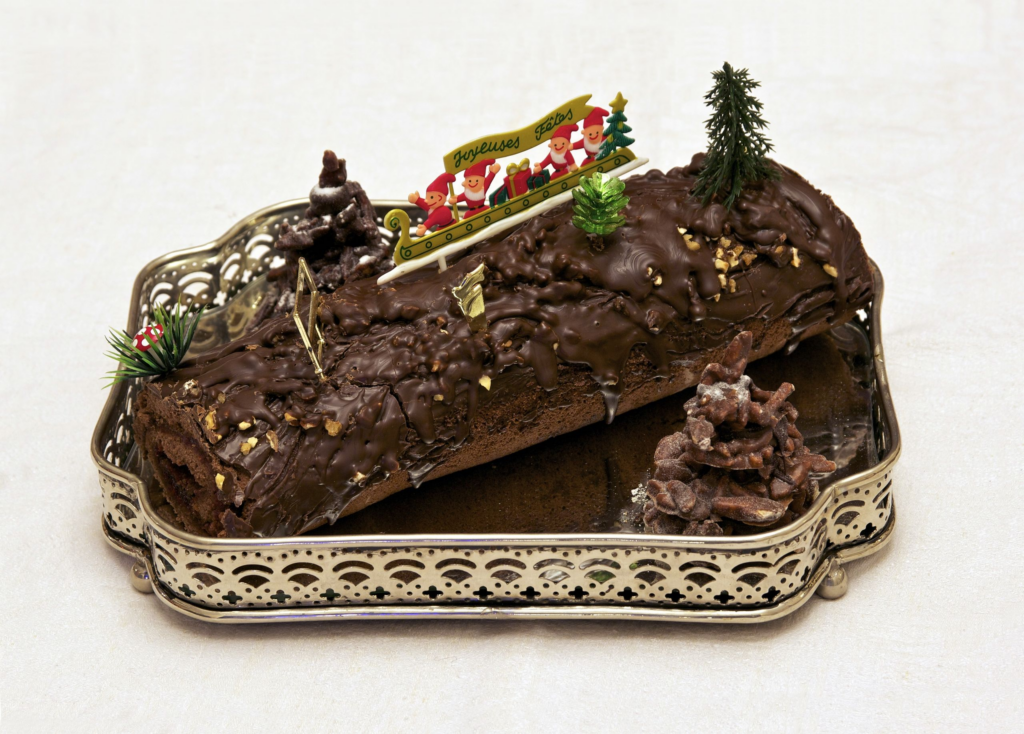
Made of sponge cake, to resemble a miniature actual Yule log, it is a form of sweet roulade. The cake emerged in the 19th century, probably in France, before spreading to other countries. It is traditionally made from a genoise, generally baked in a large, shallow Swiss roll pan, iced, rolled to form a cylinder, and iced again on the outside. The most common combination is basic yellow sponge cake and chocolate buttercream, though many variations that include chocolate cake, ganache, and icings flavored with espresso or liqueurs exist.
Yule logs are often served with one end cut off and set atop the cake, or protruding from its side to resemble a chopped off branch. A bark-like texture is often produced by dragging a fork through the icing, and powdered sugar sprinkled to resemble snow. Other cake decorations may include actual tree branches, fresh berries, and mushrooms made of meringue or marzipan.
The invention of the Yule log dates back to the 19th century, although no one really knows who originated it, as the many sources contradict one another.
In any case, the Yule log as a pastry only began to gain popularity after the Liberation, in the years 1945–1950.
Item #17: In the UK, the ruling monarch makes a speech on Christmas day. Which year was the first televised Christmas day speech?
- 1921
- 1937
- 1941
- 1957
- 1961
- 1967
Item #17: Commentary
Ask Ruth to share her memories of her family listening to the Queen’s annual Christmas address that was broadcast across Canada, as a Commonwealth nation with continuing ties to England.
I am not a fan of “the Royals,” however, this 20 minute overview of the Royals and Christmas is mildly interesting. 😉

Item #18: To which country is the poinsettia plant native / indigenous?
- Indonesia
- Italy
- Madagascar
- Mexico
- Portugal
- Spain
Item #18: Commentary [A few excerpts from the lengthy Wikipedia article on Poinsettia}
Wild poinsettias occur from Mexico to southern Guatemala, growing on mid-elevation, Pacific-facing slopes. One population in the Mexican state of Guerrero is much further inland, however, and is thought to be the ancestor of most cultivated populations. Wild poinsettia populations are highly fragmented, as their habitat is experiencing largely unregulated deforestation. They were cultivated by the Aztecs for use in traditional medicine. They became associated with the Christmas holiday and are popular seasonal decorations. Every year in the United States, approximately 70 million poinsettias of many cultivated varieties are sold in a six-week period. Many of these poinsettias are grown by Paul Ecke Ranch, which serves half the worldwide market and 70 percent of the US market.
Interesting Facts: Are the Plants Toxic?
Poinsettias are popularly, though incorrectly, said to be toxic to humans and other animals. This misconception was spread by a 1919 urban legend of a two-year-old child dying after consuming a poinsettia leaf. In 1944, the plant was included in H. R. Arnold’s book Poisonous Plants of Hawaii on this premise. Though Arnold later admitted that the story was hearsay and that poinsettias were not proven to be poisonous, the plant was thus thought deadly. In 1970 the US Food and Drug Administration published a newsletter stating erroneously that “one poinsettia leaf can kill a child”, and in 1980 they were prohibited from nursing homes in a county in North Carolina due to this supposed toxicity.
An attempt to determine a poisonous dose of poinsettia to rats failed, even after reaching experimental doses equivalent to consuming 500 leaves, or nearly 1 kg (2.2 lb) of sap.
Contact with any part of the plant by children or pets often has no effect, though it may cause nausea, diarrhea, or vomiting if swallowed. External exposure to the plant may result in a skin rash for some.
A survey of more than 20,000 calls to the American Association of Poison Control Centers from 1985–1992 related to poinsettia exposure showed no fatalities. In 92.4% of calls, there was no effect from exposure, and in 3.4% of calls there were minor effects, defined as “minimally bothersome”.
Similarly, a cat’s or dog’s exposure to poinsettias rarely necessitates medical treatment. If ingested, mild drooling or vomiting can occur, or rarely, diarrhea. In rare cases, exposure to the eye may result in eye irritation. Skin exposure to the sap may cause itchiness, redness, or swelling. It can induce asthma and allergic rhinitis in certain groups of people.
Will Poinsettias be renamed?
The Poinsettia plant derives its common English name from Joel Roberts Poinsett, the first United States minister to Mexico, who is credited with introducing the plant to the US in the 1820s; however, there have been recent efforts to rename the flower to its Nahuatl name, “cuetlaxōchitl”, due to Poinsett’s involvement in slavery and the Trail of Tears. Poinsett was extremely well-traveled.