
NOTE: The correct answer in each case is highlighted in red bold.
Item 5: In which book of the Bible can one read the story of angels appearing to shepherds in the hills, telling them to go into Bethlehem and find the baby Messiah?
- The Gospel According to John
- The Gospel According to Luke
- The Gospel According to Mark
- The Gospel According to Matthew
- The Gospel According to Paul <— Fake. There is no such thing “Gospel”.
Item # 5: Commentary
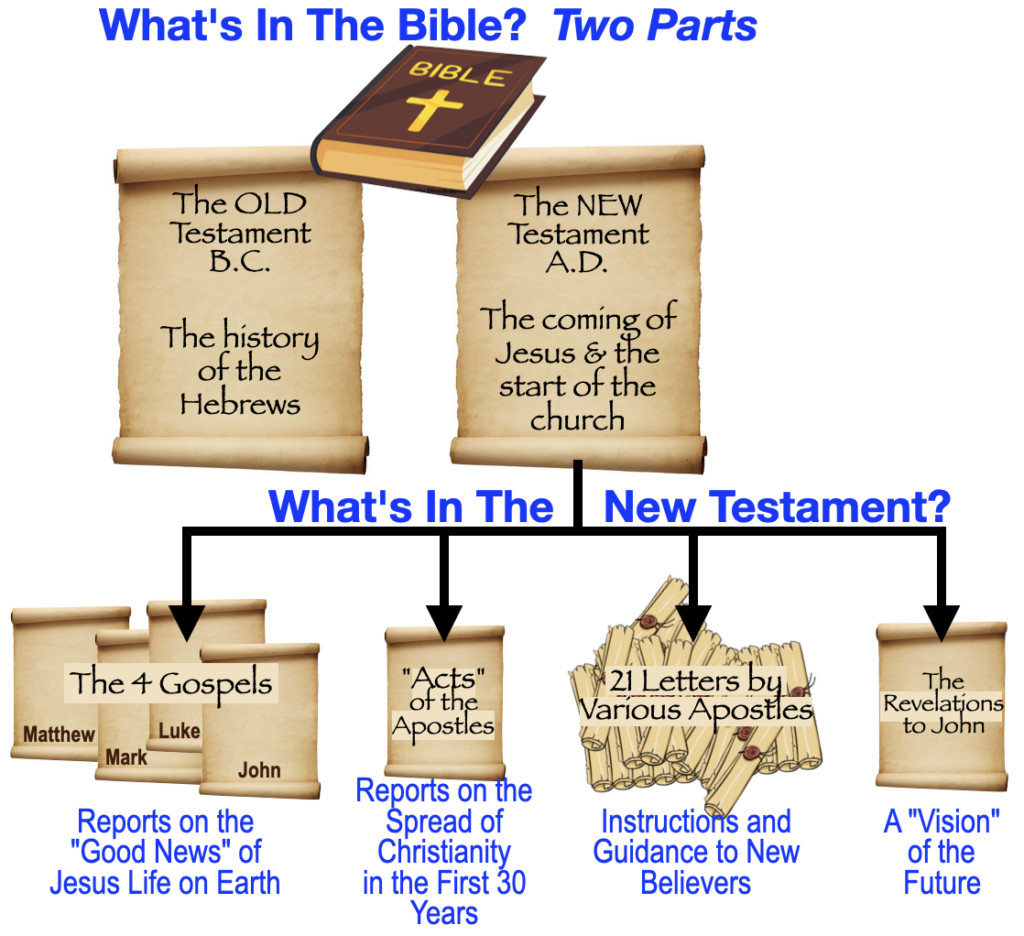
- –> There are 27 “books” in the New Testament. The first four books are also called Gospels.
- –> Gospel means “Good News.” Each of the 4 accounts of Jesus’ life have similarities and differences.
- –> The birth of Jesus the Christ (what we now call Christmas) is only described in two of the Gospels: Matthew’s Gospel and Luke’s Gospel and they both describe different things about the birth. (Mark and John’s Gospels begin their accounts of Jesus from the time that he begins his public ministry. That is, he is already an adult in his mid to late 20s.)
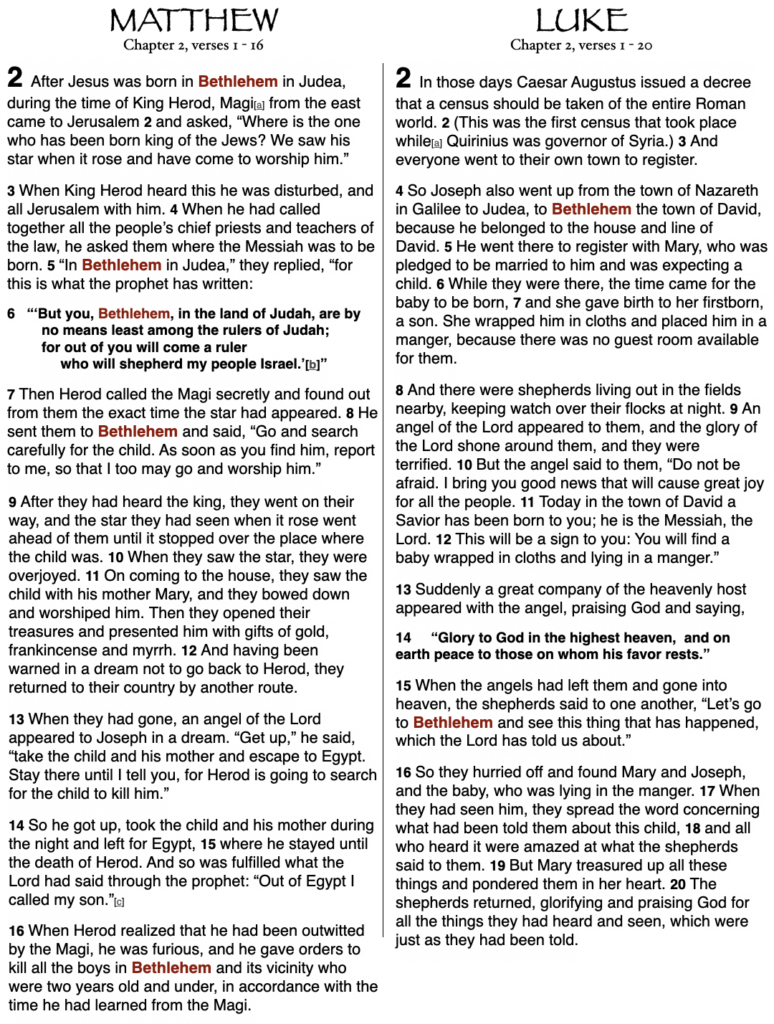
- –> The description of Mary’s reaction to her pregnancy, the reason for Mary and Joseph’s travel (government decree to go to your place of ancestry, be counted [census], and be taxed), the deascription of couple’s travel to Bethlehem, the actual birth “in a manger,” and the visit from the shepherds… is in Luke’s account, but not in Matthew’s account.
- –> The description of Joseph’s reaction to Mary’s pregnancy and the subsequent visit of the “wise men” from the East [probably months after his birth]… is in Matthew’s account, but not in Luke’s account.
- –> Our popular notion of the manger scene, the creche, is inaccurate and contributes to confusion. The shepherd’s visit to the infant did not occur at the same time (perhaps not even the same year) as the wise men’s visit to the child.
Reading the Bible Online
An excellent place to read the Bible online in different versions is BibleGateway.com. You can read the Bible in any one of many English translations. It’s free. (A monthly fee is only for people who also want to have access to many Bible Commentaries (books by scholars who offer their interpretations and understanding).
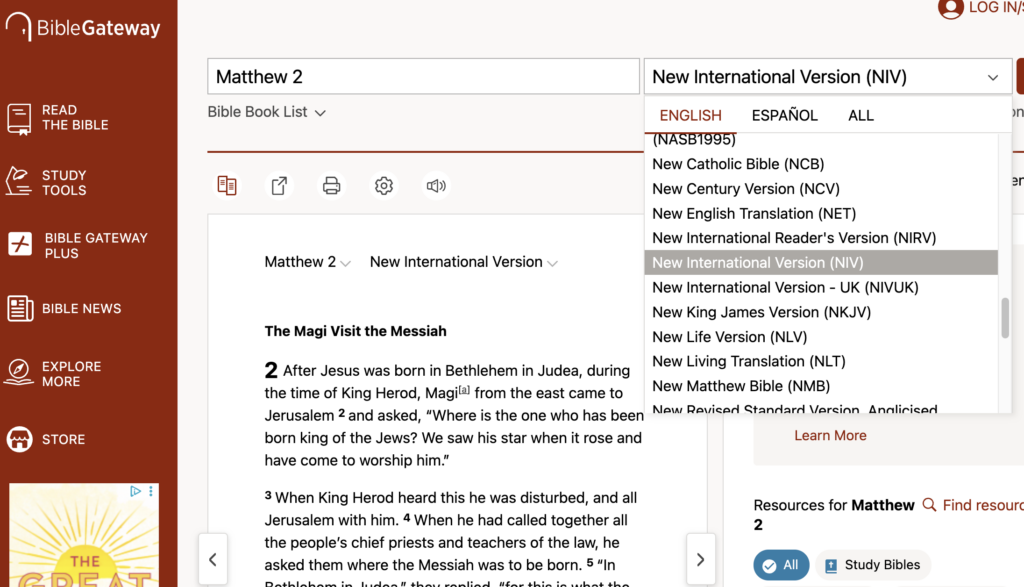
Here is a sample page in which the NIV version is selected to read Matthew, chapter 2.

Item 6: Which Gospel book tells a partial account of the birth of Jesus, specifically referring to the town of Bethlehem?
- The Gospel According to Luke
- The Gospel According to Mark <— Mark’s account does not include the birth of Jesus; see commentary above for Question 5.
- The Gospel According to Matthew
- BOTH A and C
- NONE of the above
Item # 6: Commentary
Bethlehem, As Mentioned in Matthew and Luke:
Item 7: Which phrase is NOT written in the Bible accounts of Jesus’ birth?
- There was no room for them [Jesus, Mary, and Joseph] in the inn.
- There were shepherds living out in the fields nearby, keeping watch over their flocks at night. An angel of the Lord appeared to them, and the glory of the Lord shone around them, and they were terrified.
- Today in the town of David a Savior has been born to you; he is the Messiah, the Lord.
- Three wise men from the east came to Jerusalem.
- On coming to the house, they [the wise men] saw the child … and presented him with gifts of gold, frankincense and myrrh.
- Herod … was furious, and he gave orders to kill all the boys in Bethlehem and its vicinity who were two years old and under,…
Item # 7: Commentary
| A) There was no room for them [Jesus, Mary, and Joseph] in the inn. | Luke 2:7b — As translated in 3 versions. [KJV King James Version] And she brought forth her firstborn son, and wrapped him in swaddling clothes, and laid him in a manger; because there was no room for them in the inn. [MSG The Message] She wrapped him in a blanket and laid him in a manger, because there was no room in the hostel. [NIRV New International Reader’s Version] She wrapped him in large strips of cloth. Then she placed him in a manger. That’s because there was no guest room where they could stay. |
| B) There were shepherds living out in the fields nearby, keeping watch over their flocks at night. An angel of the Lord appeared to them, and the glory of the Lord shone around them, and they were terrified. | <– Luke 2:8-9 from the NIV [New International Version] |
| C) Today in the town of David a Savior has been born to you; he is the Messiah, the Lord. | <– Luke 2:11 from the NIV [New International Version] |
| D) | <– Matthew 2:1 from the NIV [New International Version]. NO WHERE does the Bible say HOW MANY wise men (kings, Magi) came from the East to worship a new king. MORE ABOUT THIS BELOW. |
| E) On coming to the house, they [the wise men] saw the child … and presented him with gifts of gold, frankincense and myrrh. | <– Matthew 2:11 from the NIV [New International Version]. |
| F) Herod … was furious, and he gave orders to kill all the boys in Bethlehem and its vicinity who were two years old and under,… | <– Matthew 2:16 from the NIV [New International Version]. |
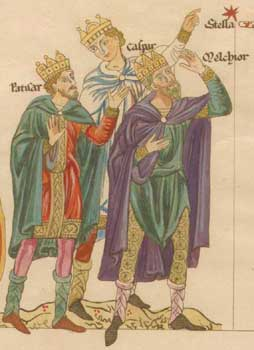
The number of “wise men” is not in the Bible. There is a tradition of “three kings” that traces back to at least the tenth century. Perhaps the number of kings arises from an assumption that the three gifts (gold, frankincense, and myrrh) mentioned in Matthew 2:11 are the ONLY gifts and that EACH KING brings ONLY ONE gift. In 1857, an American theology student wrote both the music and lyrics of the Christmas carol, “We Three Kings of Orient Are,” for purposes of a Christmas pageant [play] at his college. The song provides three verses to be sung as solos where each wise man describes his “gift” for the young Jesus.
IMAGE: The three Magi (named Balthazar, Caspar, and Melchior), from Herrad of Landsberg‘s Hortus deliciarum (12th century)
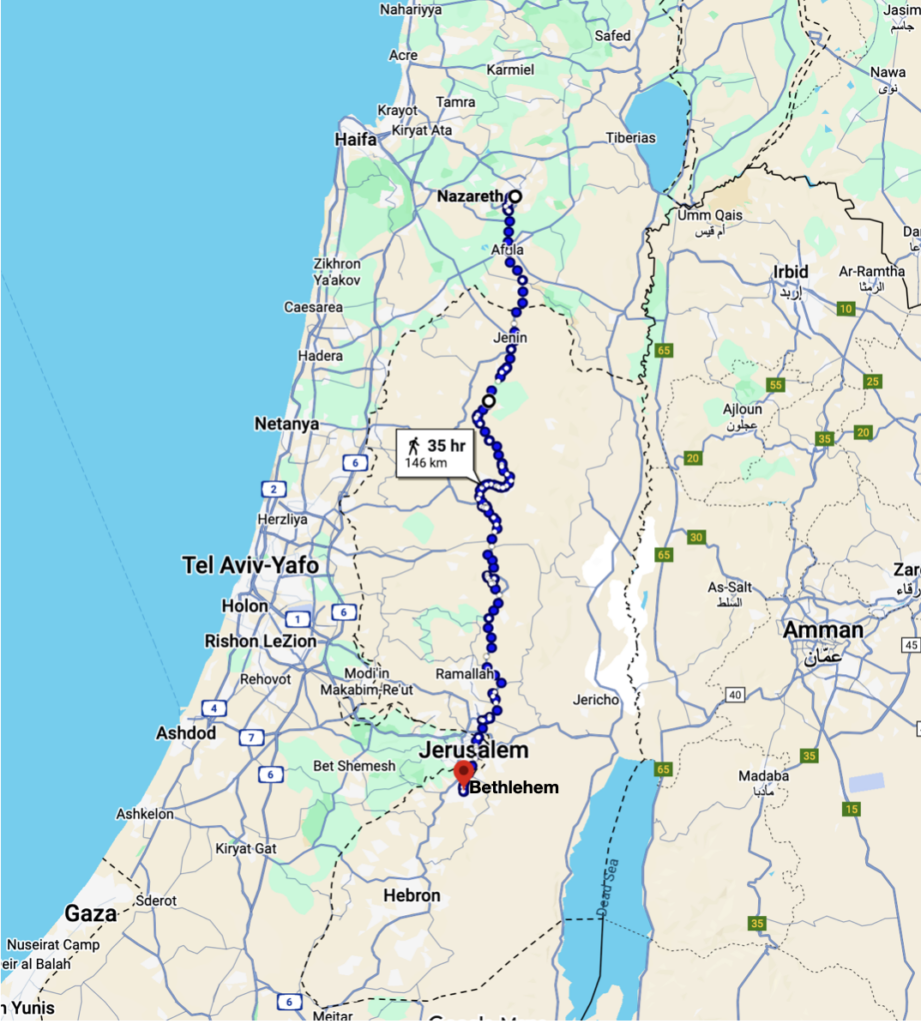
Item 8: From Bethlehem (Jesus birthplace) to Nazareth (Jesus hometown until about 26 years old) it would be about a five day walk (about 7 hours of walking per day). In what general direction would one need to walk?
- Roughly, due north.
- Roughly, due south.
- Roughly, due east.
- Roughly, due west.
Item # 8: Commentary
The correct answer to the question is “A – Roughly, due north.”
But if we are talking about Mary (9 months pregnant) and Joseph making this trip 2000+ years ago, it is not likely that they could do 7 hours a day (continuous walking!). Make your own estimate of how many days it might have been.
Map
Item # 9: The Old Testament has many passages that are believed to predict the coming of Jesus the Messiah some 700 years prior to Jesus’ birth. For example this passage appears to predict the place of the Messiah’s birth: “But as for you, Bethlehem Ephrathah, Too little to be among the clans of Judah, From you One will come forth for Me to be ruler in Israel. His times of coming forth are from long ago, From the days of eternity.” [NASV]. These are the words of what prophet?
- Amos
- Isaiah
- Micah
Item # 9: Commentary
The passage quoted is from Micah 5:2.
Matthew, the reviled tax collector decided to follow Jesus as one of the twelve disciples, and later includes this personal incident in his account of Jesus (Matthew 9:9-13).
In writing what he knew about the birth of Jesus, he appears to have cited Micah 5:2 as knowledge that Jewish religious leaders gave to King Herod when he duplicitously asked them where the Messiah would be born. (Scroll back up to the Commentary on Item #6, and then read Matthew 2:5-6.) No, it is not word for word the same, but he was working from memory.
While the job of the Old Testament prophets was to “prophesy,” that generally meant “speaking truth to power” (as we would say). Most of what you read in the Old Testament prophets are warnings directed at the Jewish kings (of Judah and Israel), and to their citizens, to stay loyal to Jehovah God and to live righteous lives. The dictionary definition of predicting the future also happens, most frequently warning of the coming collapse of Israel and then Judah.
Still a few passages throughout the Old Testament are cited by Bible believers as predictions of the birth and death of Jesus the Son of God. Here are 11 such passages.
Item # 10: What is wassail?
- A boat
- A Christmas song
- A harness for a reindeer
- A type of European hedgehog
- An alcoholic drink
- An apple and raisin pie
Item # 10: Commentary [Copied from the YouTube video below]
The word ‘Wassail,’ is a blend of the Old Norse, ‘ves heill,’ and the Old English, ”hál wes þú’ or ‘wes hál,’ which translates to, ‘be in good health,’ and was used as a greeting (hail) and a farewell. It then became linked to drinking alcohol amongst the Anglo-Danish and Anglo-Saxon populations of England who used the phrase, ‘wes heil…drinc heil,’ amongst many other variations.
Wassail then also became the name for a hot alcoholic drink, using either mead or cider mulled with spices and fruit, served and shared round in a bowl.
The act of Wassailing is also an ancient tradition, whereby villagers drink and sing round the trees in the apple orchard to awaken the trees and scare away evil spirits, ensuring a good harvest for the coming year. There are many wonderful variations of this ritual, including hanging toast soaked in cider in the trees for the robins, who represent the good spirits.
There are a variety of Wassail songs, but the most popular has been associated with other carols that might be sung to neighbors:
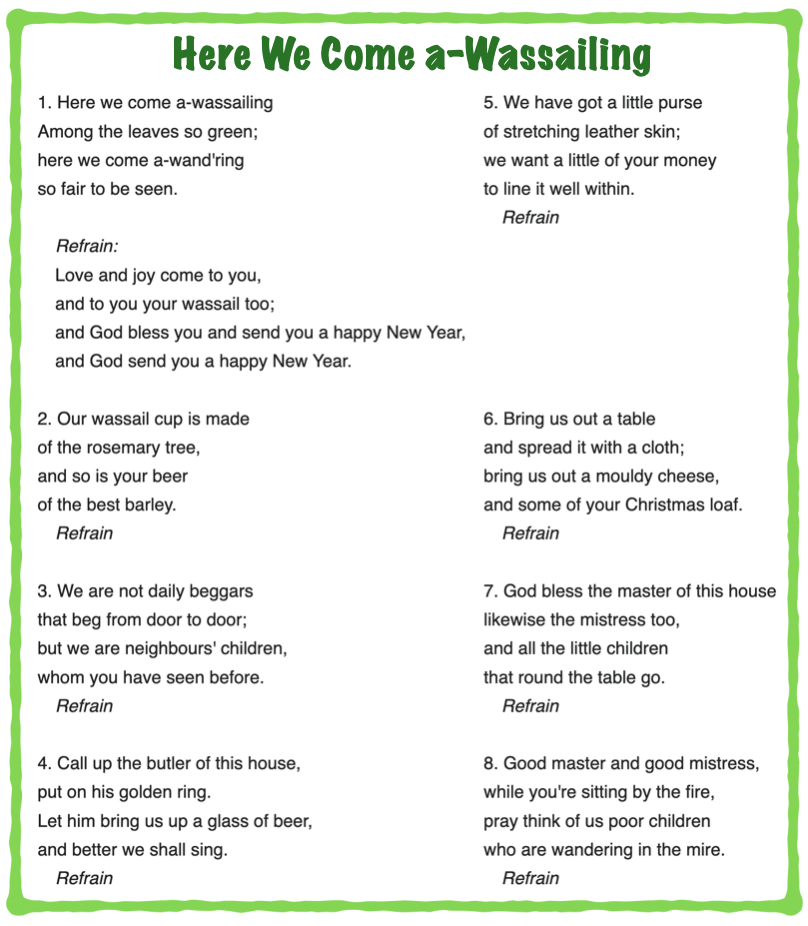
The song is sung from the perspective of the poor, who travel from door to door in the tradition of carol singing visiting the more wealthy, asking for Christmas gifts, including money, Christmas loaf, mouldy cheese and of course, beer!
Here is a great rendition found on YouTube by Henry Bard:
The location for this video [he writes] is once again at the amazing Ryedale Folk Museum, Hutton Le Hole, North Yorkshire, England. It is in their beautifully restored Victorian thatched cottage, that was saved from destruction and lovingly reconstructed at the museum. They kindly let me film for free in return for singing this song for them. I heartily recommend a visit! More information can be found at www.ryedalefolkmuseum.co.uk
Sources: The lyrics in the green frame come from the relevant Wikipedia article here. The remainder of the “commentary” is copied from the information associated with the Henry Bard video. If you click on the “Watch on YouTube” button you can see it all under the video there.
Item # 11: In England, it’s considered good luck to find which of these in your Christmas pudding?
- A cherry
- A coin
- A four leaf clover
- A holly sprig
- A sultana [a small, light brown seedless raisin]
- A very small horseshoe charm
Item # 11: Commentary
First of all, do you really know what a “Christmas Pudding” or aka “Plum Pudding” consists of? Here is a well known chef showing you how they are made … and set afire!
As for the insertion of coins (which Jamie omitted)….
Putting Coins (and other items) into Christmas Puddings
Putting a silver coin in the pudding is another age-old custom that is said to bring luck to the person that finds it. In the UK the coin traditionally used now is a silver ‘sixpence’. The closest coin to that now is a five pence piece!
The tradition seems to date back to the Twelfth Night Cake which was eaten during the festivities on the ‘Twelfth Night’ of Christmas (the official end of the Christmas celebrations). Originally a dried pea or bean was baked in the cake and whoever found it was ‘king or queen’ for the night. There are records of this practice going back to the court of Edward II (early 1300s). The bean was also sometimes a silver ring of small crown.
The first coins used were a Silver Farthing or penny. After WWI it became a silver threepenny bit. In 1937 the Threepence coin changed design (and also became made from mostly brass) so the silver sixpence took over as the pudding coin. The UK’s Royal Mint still makes special ‘Christmas Silver Sixpence’ coins every year which you can use in puddings – but they cost a lot more to buy than sixpence! Some families still use old silver threepenny bits in their puddings.
You might also get other items (sometimes called ‘tokens’ or ‘favours’) placed in the Christmas Pudding which also meant to have special meanings:
- –>Bachelor’s Button: If a single man found it, they would be stay single for the following year.
- –>Spinster’s/Old Maid’s Thimble: If a single woman found it, they would be stay single for the following year.
- –>A Ring: If a single person found this, it meant you will get married in the following year! It can also mean you will be rich for the following year.
(The coin information came from: James Cooper at https://www.whychristmas.com/customs/christmas-pudding)